 Appletun Grove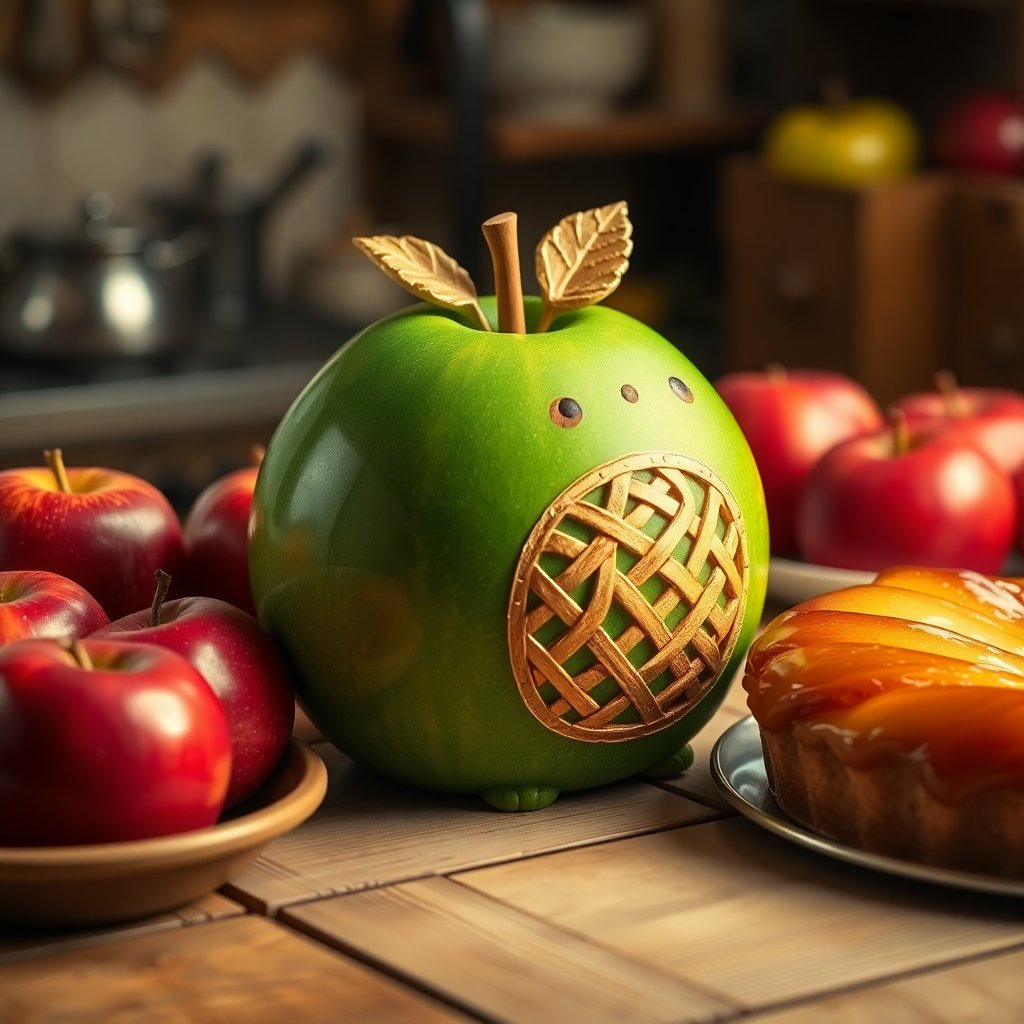
Few Pokémon wear their concept as plainly as Appletun does. A rounded green shell, a lattice of golden ridges, a drowsy face peeking out from under an apple — it reads like dessert before it reads like a monster. Yet the moment you ask a simple question — why is a sleepy apple pie classified as a Dragon — the design opens up into a surprisingly deep well of wordplay, cooking history, and old European myth. This is the story of where the apple dragon actually comes from.
The pun hiding in plain sight
Start with the most literal reading. Look at Applin, Appletun's pre-evolution: it is a worm curled up inside an apple, peeking out through a hole in the skin. That image — a grub burrowing into fruit — is the seed the whole line grows from. According to Bulbapedia's Appletun entry), the design is "based on the popular image of a worm burrowing into an apple, as well as a pun on the wyrm, a type of dragon."
That second half is the clever part. "Wyrm" (also spelled worm or wurm) is an archaic Germanic term for a dragon — specifically a long, serpentine, often legless one. So a worm in an apple becomes a wyrm in an apple, and a garden pest quietly graduates into a Dragon-type. The English language did the heavy lifting; the designers just noticed the joke was sitting there the whole time.
Once you see it, the typing stops being arbitrary. Appletun is not a dragon because it is fierce. It is a dragon because of a homophone that is roughly a thousand years old.
What a "wyrm" actually was
To appreciate the gag, it helps to know what a wyrm meant to the people who coined the word. In wider Germanic mythology, wyrm (Old English), ormr (Old Norse), and wurm (Old High German) all meant "serpent," and were the standard words for what we would now call dragons. As Wikipedia's overview of the Germanic dragon explains, these creatures were typically pictured as huge venomous snakes that coiled around hoards of gold rather than the winged, fire-breathing beasts of later fantasy.
From that root grew the Lindworm (German Lindwurm), a wingless, serpent-bodied dragon of Northern and Central European legend. Depending on the region it had two small forelimbs or none at all, and in some Swedish traditions it was purely limbless — a giant snake with a dragon's head that lurked near water waiting to ambush prey.
Set a Lindworm next to Appletun and the resemblance is quiet but real: a stout, low-slung, limbless-looking body, more reptile than raptor. Appletun even carries a tortoise-like heaviness, trading the Lindworm's menace for a nap. The apple line keeps the shape of the old European dragon while draining out all the danger — which is exactly the kind of gentle reinterpretation that makes these designs so easy to love. If you enjoy tracing how the line's body plan shifts across its branches, our guide to Appletun's forms and regional variants walks through how Applin splits into two very different silhouettes.
Then there is the dessert
The dragon half explains the typing. The other half of Appletun is unapologetically food.
Its back is not just green — it is baked. The golden lattice across the shell mimics the woven top crust of a classic apple pie, and its rounded, slumped shape echoes an apple turnover, the folded pastry that so often hides apples inside. The Pokédex leans all the way into this: Appletun's body is described as caked in sweet nectar whose smell lures in Bug-type Pokémon it then preys on, its diet is mainly sweet apples, and — the detail that makes people wince and grin at once — the skin on its back is said to be so tasty that children used to peel some off as a snack.
The naming reinforces the pastry theme across languages, and this is where it gets genuinely fun:
- English "Appletun" blends apple, Appleton (an old English place-name meaning a spot where apples grow), ton (a unit of weight, a nod to its bulk), apple turnover, and under.
- Japanese "Tarupple" mixes tart, tarui (sluggish), tappuri (an onomatopoeia for "plenty"), and apple.
- French "Dratatin" is the tidiest of all — a straight fusion of dragon and tarte tatin.
That French name points at a specific dish with a great backstory. Tarte Tatin is an upside-down caramelized apple tart, supposedly created by accident at the Hôtel Tatin in France when a cook overcooked apples in butter and sugar, then rescued the mess by laying pastry on top and flipping the whole thing out of the pan. An upside-down apple dessert born from a happy mistake is an almost perfect match for a chubby, upside-down-looking apple dragon.
A dragon that bursts after a cake?
Here is the deep-cut reference that most fans miss. Beyond the pun and the pastry, Appletun's design may nod to the tale of Bel and the Dragon, an old text in which a dragon is fed a cake and bursts open. It is an obscure thread, and it is worth hedging — this is a plausible reading rather than a confirmed developer statement — but it fits the pattern the designers clearly enjoy: taking a food-plus-dragon story from the historical record and folding it into a single friendly creature.
The Gigantamax form extends the same logic, ballooning Appletun into something modeled after a caramel apple, a candy apple, or a whole baked apple. The bigger it gets, the more dessert it becomes. That is the joke the whole line runs on, scaled up.
Why the origin makes it a better collectible
Knowing the roots changes how the merch reads. An Appletun plush is not just a cute blob — it is a wyrm wearing an apple pie, a small monument to a medieval word-joke. That backstory is genuinely useful when you are building a themed shelf and want each piece to mean something.
A few directions collectors chase once the folklore clicks:
- The plush itself, which captures the tortoise-slump and the apple crown better than any card art. → Shop Appletun plush on Amazon
- The full apple line, so Applin's worm-in-fruit origin sits right next to the evolved dragon and tells the whole story at a glance. → Shop Applin and Appletun figures on Amazon
- A real apple-pie or tarte-tatin baking kit, which turns the design origin into an afternoon in the kitchen and makes a fitting centerpiece for an apple-dragon display. → Shop apple pie baking kits on Amazon
Grouping pieces by story rather than by size or set gives a collection a through-line that visitors immediately understand. For more on staging a themed shelf so those connections read clearly, our Appletun collection display ideas post covers lighting, risers, and grouping. And because plush and painted figures both fade or scuff over time, a little upkeep protects the story you are telling — our Appletun care guide has the basics.
The takeaway
Appletun is one of those designs that rewards a second look. On the surface it is a dozy apple pie with legs. Underneath, it braids together a Germanic word for dragon, a wingless serpent from Northern European legend, an upside-down French tart with an origin myth of its own, and a garden pest's-eye view of a piece of fruit. The apple dragon is cozy precisely because it takes something ancient and a little eerie — the wyrm coiled around its hoard — and reimagines it as dessert you could almost take a bite of.
That is the quiet genius of the Applin line, and it is why the apple dragon has a fandom at all. The more you know about where it came from, the more there is to love sitting on the shelf.
Affiliate disclosure: some links above are Amazon affiliate links, and Appletun Grove may earn a small commission on qualifying purchases at no extra cost to you. Design and folklore details are drawn from community references and historical sources; interpretive readings are noted as such and should be treated as informed analysis rather than official developer confirmation.